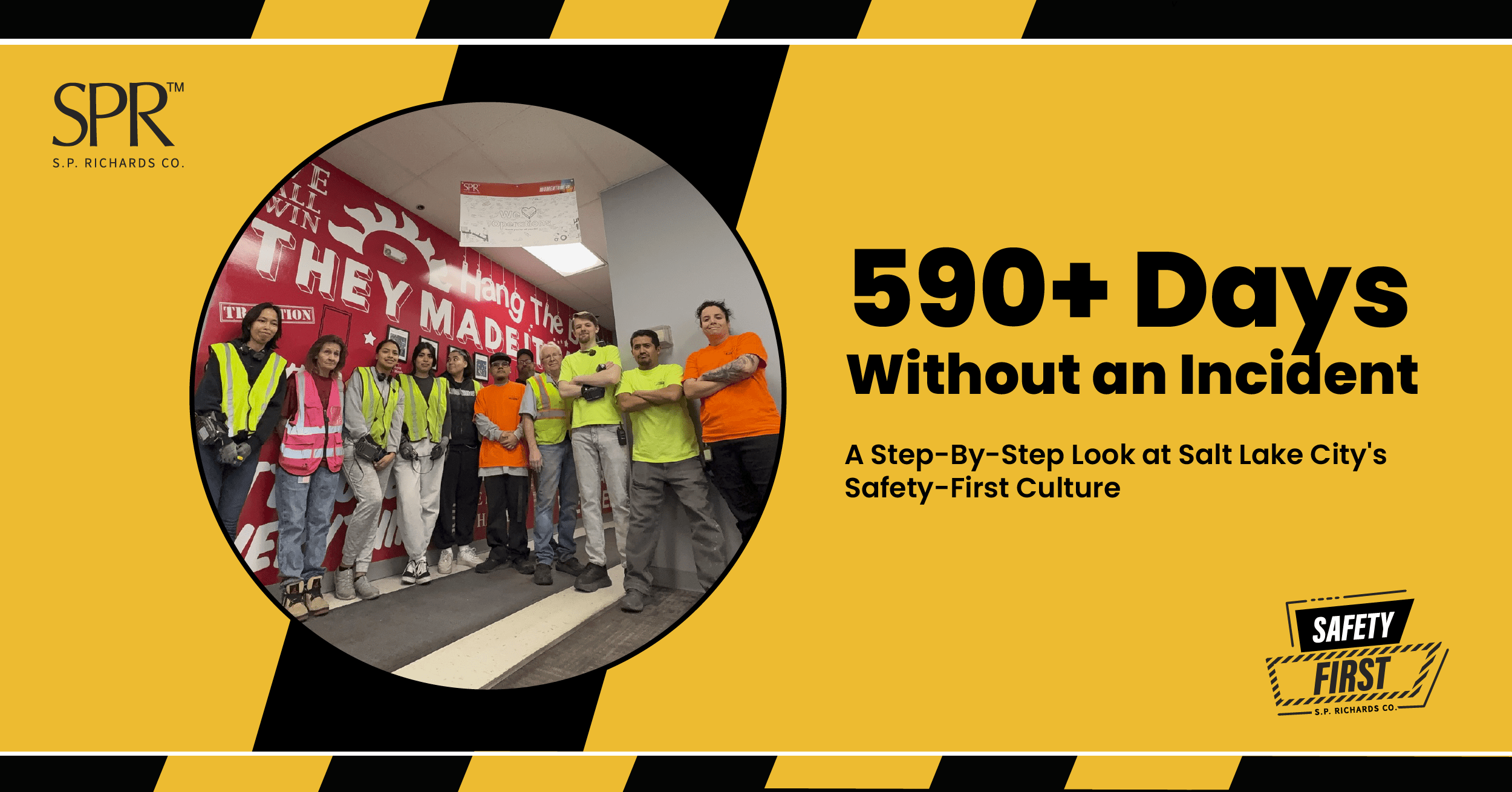
When operations scale quickly, safety systems are tested. At S.P. Richards’ Salt Lake City Distribution Center (DC), rapid growth, new employees, and a surge in inventory could have introduced added risk. Instead, the team has maintained an incident-free streak of more than 590 days through a consistent, behavior-driven approach to safety.
At the center of that success is DC Manager Astrid Artiga and a team that has built safety into every layer of daily operations.
Below is a step-by-step look at how the Salt Lake City DC has sustained its safety performance.
Step 1: Make Safety a Daily Operating Standard
The foundation of Salt Lake City’s safety performance is consistency.
“The biggest contributor was keeping safety at the forefront of everything we do,” Astrid explains. “It is part of our daily conversations.”
Rather than treating safety as a monthly initiative, the team reinforces it continuously as part of normal operations.
Step 2: Reinforce Safety in Every Touchpoint of the Day
Safety is not limited to formal meetings—it is embedded into daily workflow moments.
“We discuss safety every day,” Astrid says. “Whether it’s start-up meetings, coaching opportunities, walk-throughs, or operational challenges, safety remains a priority.”
This repetition helps normalize safe decision-making, even during peak volume periods.
Step 3: Prioritize People Over Productivity
A core principle in Salt Lake City’s culture is that no operational goal outweighs safety.
“We remind our employees that we can replace products, equipment, and materials, but we cannot replace people,” Astrid shares. “We encourage employees to slow down, assess risks, and never sacrifice safety for productivity.”
This mindset drives behavior in high-pressure environments.
Step 4: Build a Culture of Learning, Not Blame
Sustained safety performance requires trust and transparency.
“Our focus is understanding what happened, identifying root causes, and preventing future occurrences,” Astrid explains. She emphasizes that creating an environment of trust strengthens honest communication and reinforces the safety culture.
Instead of reacting to incidents, the team focuses on prevention and continuous improvement.
Step 5: Start Safety Training on Day One
New employees are introduced to safety expectations immediately.
“Safety training begins on day one,” Astrid says. “New employees receive safety orientation, hands-on training, and clear expectations regarding safe work practices.”
This ensures consistency even as the team grows and evolves.
Step 6: Reinforce Standards Through Visibility
Safety expectations are made visible throughout the facility.
The DC uses an accident-free board placed in the main office so every employee sees it when entering the branch, reinforcing accountability and awareness on a daily basis.
Step 7: Leverage Veteran Employees as Safety Mentors
Experienced employees play a critical role in sustaining culture.
“Our veteran employees play a critical role in mentoring newer team members,” Astrid explains. “They demonstrate safe behaviors, reinforce procedures, and encourage questions.”
This peer-to-peer reinforcement strengthens consistency across shifts.
Step 8: Lead with Consistency, Not Campaigns
Long-term safety success is driven by leadership behavior, not short-term initiatives.
“Make safety a daily conversation, not an occasional initiative,” Astrid says. “Leadership must demonstrate that safety comes before productivity, and employees must feel comfortable speaking up.”
She adds that consistency at every level is what sustains results.
Step 9: Sustain Performance Through Cultural Discipline
Salt Lake City’s results are not tied to one initiative. They are the outcome of sustained discipline across behaviors, training, and leadership alignment.
“Celebrate safe behaviors, address risks proactively, and maintain accountability at every level,” Astrid explains. “When safety becomes part of the culture rather than just a program, incident reduction naturally follows.”
A Culture Built for Scale
Salt Lake City’s 590+ day incident-free streak demonstrates that safety and growth are not competing priorities. With consistent habits, visible reinforcement, and leadership alignment, the DC has built a model that scales.
At S.P. Richards, this approach reflects a simple belief: simplifying complexity. When safety is embedded into clear, repeatable actions, strong performance follows naturally.